
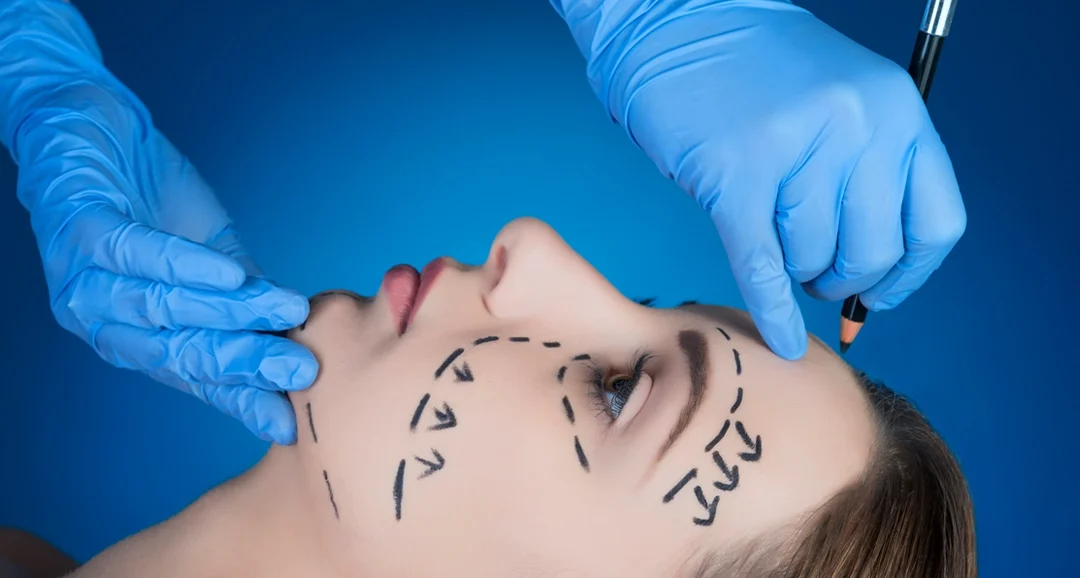
Who is a Good Candidate for a Mini Facelift?
We often recommend a mini facelift for a younger patient in their forties to early fifties who have:
- Mild/modest age-related descent of the facial soft tissues
- Good skin elasticity
- Minimal neck banding
A mini facelift can sharpen the jawline and lift the cheeks with a more streamlined recovery. That said, a mini facelift is not a solution for everyone. If you have significant neck laxity, pronounced jowls, deep folds, or visible platysmal bands, a full facelift may provide a more suitable and longer-lasting correction.
GLP-1 Weight Loss, Volume Loss, and Sagging
Rebalancing Deflation and Descent
Rapid weight loss from GLP-1 medications can leave you with volume loss, sagging skin, or sunken cheeks. In carefully selected patients, a mini facelift can re-suspend mild cheek and jowl descent for a more lifted contour. We may combine surgery with fat transfer or volume enhancers to restore lost volume. When deflation and skin excess are more advanced—especially in the neck—a full facelift (often with a neck lift) may be the better path to harmonious rejuvenation.
Who is a Good Candidate for a Full Facelift?
A full facelift is often the best option for patients with more advanced signs of facial aging that extend beyond the lower face. Good candidates typically have moderate to significant skin laxity, deeper folds around the mouth and nose, pronounced jowling, and loose skin or banding in the neck area. Unlike a mini facelift, which focuses primarily on early aging in the jawline and lower cheeks, a full facelift addresses the midface, jawline, and neck for more comprehensive rejuvenation.
You may be a good candidate for a full facelift if you have:
- Moderate to severe sagging in the cheeks and jawline
- Deep creases around the nose and mouth
- Jowls or loss of definition along the jawline
- Loose skin or visible banding in the neck
- Concerns that cannot be fully addressed with less invasive procedures
Many patients considering a full facelift are in their 50s, 60s, or older, though age alone is not the determining factor. The best candidates are healthy non-smokers with realistic expectations who want longer-lasting and more dramatic improvement in facial contours. A full facelift may also be appropriate for younger patients who experience significant facial sagging due to genetics or weight changes.
Where Dermaplaning, Hydration, and Skin Protection (a.k.a. SPF) Fit In
Post-surgical care is an important consideration when it comes to maintaining the beautiful result of your facelift. Facial harmony and skin quality are not corrected in a “one-and-done” procedure. By incorporating beneficial treatments, proper hydration and skin protection into your routine, you are healthfully protecting your investment in yourself.
Dermaplaning is a non-surgical exfoliation treatment that gently removes dead skin cells and fine vellus hair to reveal smoother, brighter, more radiant skin. It’s perfect for sensitive skin as no chemicals are used. It complements post-surgical rejuvenation by refining skin texture and enhancing overall glow.
Along with dermaplaning, many patients incorporate hydrating treatments such as Dermasweep® into their ongoing post-facelift maintenance routine to help keep skin refreshed and healthy-looking. Medical-grade skincare products, including Hydrating Peptide Serum and daily SPF protection, are also important for maintaining skin quality and protecting results.
Additionally, the Whole Beauty Institute offers patients customized post-care treatment plans tailored to their skin concerns, healing process, and long-term aesthetic goals. Results vary based on individual anatomy, healing, and lifestyle factors.